Here is the rewritten article with all headings and important words wrapped in tags:
From Learning to Livelihood Readiness
Learning a skill is a beginning. A deeply important beginning — but a beginning nonetheless. Because the real question, the one that starts to form in a woman's mind as she grows more comfortable with what she is learning, is not simply "Can I do this?" It is something larger and more personal than that. It is: "How can this become a part of my future?"
That question is the bridge between skill and possibility. And at S-kala – Shakuntala Shishu Lok, that bridge is exactly what the institution is committed to building — carefully, deliberately, and with deep respect for every woman who dares to ask it.
At S-kala, skill training is not understood as a series of classroom sessions with a defined start and end date. It is understood as a journey — a step-by-step, human journey from learning to confidence, from confidence to quality work, and from quality work to genuine livelihood readiness. Each stage matters. Each stage builds on the one before. And each stage carries within it the possibility of a quiet but real transformation in the way a woman sees herself and what she believes she deserves from her future.
Learning Is the First Step — and It Deserves to Be Taken Seriously
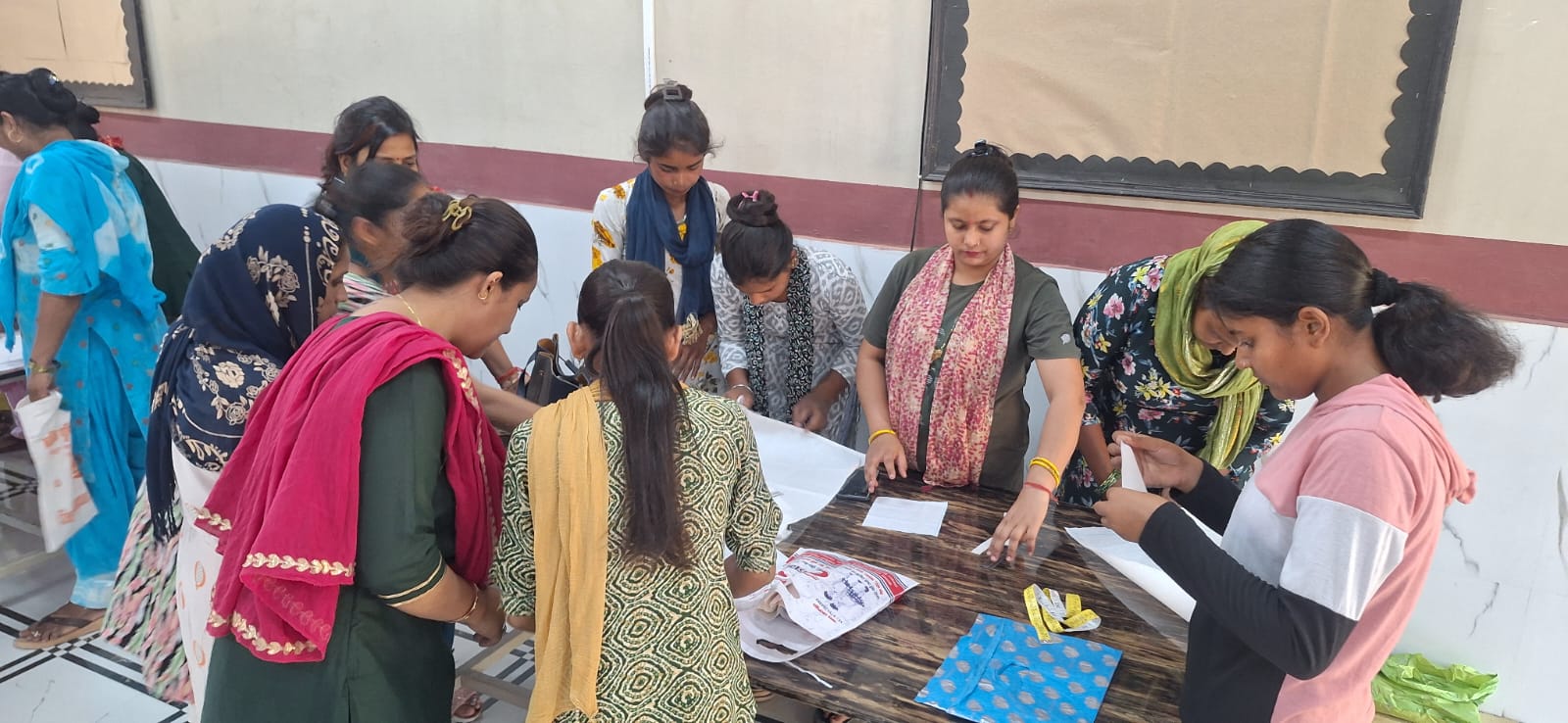
Every meaningful journey starts somewhere. At S-kala, it starts with practical skill learning — tailoring, embroidery, craft, handmade product development, and other livelihood-oriented activities that give women something real and tangible to work with.
In the beginning, nothing comes easily. And that is completely as it should be.
A design does not come out as imagined. A stitch runs slightly off the line. A product requires correction more than once. A technique that looked straightforward when demonstrated looks considerably more complex when attempted for the first time with one's own hands. The learner feels uncertain. She watches carefully before she tries. She hesitates. She wonders, more than once, whether she is really capable of getting this right.
This is not failure. This is learning — honest, real, necessary learning. And at S-kala, this stage is treated with the seriousness and patience it deserves, because without it, nothing that follows is possible.
Through regular practice, patient guidance, and consistent encouragement, the learner begins to find her footing. She starts to understand the material beneath her hands — how it behaves, how it responds, what it requires from her. She begins to understand the process, the finishing, the discipline of creating something properly rather than just creating something quickly.
This foundation is everything. Livelihood readiness cannot be built without it. A skill must first be truly understood, genuinely practiced, and honestly improved before it can carry a woman toward any meaningful opportunity.
Confidence Changes Everything
There is a particular kind of shift that happens in a training room when a learner moves from simply following instructions to actually believing in herself. It is not always dramatic. It does not always announce itself. But those who are paying attention can see it — in the way she holds her work, in the way she speaks about what she is making, in the way she begins to take initiative rather than waiting to be told what to do next.
Confidence is not a bonus that appears after skill is acquired. It is an essential part of the journey itself. And at S-kala, it is treated as such.
When a learner completes her first real product — not a practice attempt, but something finished and presentable — something changes. When her work is appreciated by a trainer or displayed for others to see, something changes. When she corrects a mistake herself, without being prompted, because she knows enough now to recognise what good looks like — something changes.
These moments build confidence in the most genuine way possible — not through praise that is given freely regardless of effort, but through the earned satisfaction of having done something well. That kind of confidence is durable. It does not collapse when things get difficult. It does not require constant reassurance. It is rooted in actual experience — in the real knowledge that she has done this before and can do it again.
And this changes her direction entirely. She becomes more willing to try difficult things. More open to correction, because correction is no longer a threat — it is information that helps her improve. She starts to take pride in her work. She begins to think of herself not merely as a learner, but as someone whose contribution has genuine value.
Livelihood readiness does not come from skill alone. It comes from the confidence to use that skill with responsibility and pride.
Quality Is What Makes a Skill Truly Useful
A skill becomes livelihood-ready when it is paired with something that many training programmes underestimate — quality.
It is not enough to complete a product. The product must be neat. It must be consistent. It must be presentable — finished in a way that reflects care and attention, not just effort. Because a handmade product that is poorly finished, however much heart went into its making, will not travel far beyond the room in which it was created.
At S-kala, learners are guided toward an understanding of quality that goes beyond the basic technique. They learn the importance of proper finishing, accurate measurement, clean presentation, and consistent standards. They learn that the small details — the neatness of a seam, the evenness of an embroidered line, the tidiness of a final product — are not minor extras. They are the things that determine whether a piece of work remains a practice exercise or becomes something that another person would genuinely want to own.
A stitched item should not merely be completed. It should be finished properly. An embroidered piece should not merely show effort. It should show care and neatness. A handmade product should not merely look creative. It should also be useful and presentable — something that speaks, without words, to the skill and seriousness of the person who made it.
This focus on quality teaches something deeper than technique. It teaches discipline. It teaches women that livelihood readiness is not about making something once and moving on. It is about making it well, making it consistently, and always looking for ways to make it better.
Product Visibility — The First Bridge Toward Opportunity
A product made in private and never seen by the world has limited power to change a life. But a product that is displayed, documented, and presented with dignity — that product begins to do something far more significant. It starts to build recognition. It starts to show the world what a woman is capable of. And it starts to open doors that were previously not even visible.
At S-kala, product visibility is understood as an essential step in the journey from learning to livelihood readiness. The institution actively supports the showcasing of women-made work — through product displays, gallery records, documentation, and deliberate, respectful presentation of what its learners have created.
When a learner sees her work displayed — when she sees others looking at it, considering it, appreciating it — something significant happens inside her. Her relationship with her own work changes. She begins to see it not as a private effort made within the walls of a training centre, but as something that has a presence in the world. Something worth seeing. Something worth taking seriously.
Visibility does not immediately guarantee income. That is important to acknowledge honestly. But it creates the first, essential bridge toward opportunity. It builds recognition — of the institution, of the learners, and of the value of handmade, skill-based work. It gives women a reason to keep improving, because improvement now has an audience. It gives the work a dignity it cannot have when it remains unseen.
A product presented properly can become part of a much larger journey.
Livelihood Readiness Is About Preparation, Not Just Income
It is important to be honest about what livelihood readiness actually means — because it is frequently misunderstood.
Livelihood readiness does not mean that every woman who completes a training programme at S-kala will immediately begin earning an income. That would be an unrealistic and ultimately unhelpful promise. What it means is something more considered and more lasting than that.
It means she understands her skill — not just mechanically, but with genuine comprehension of what she is doing and why. It means she can practice with confidence — independently, without requiring constant direction. It means she understands the importance of quality and takes responsibility for maintaining it. It means she is capable of completing work responsibly — on time, with care, to a consistent standard. It means she genuinely believes that her effort has value — not just as practice, but as real, meaningful work. And it means she is open to future opportunity — ready to step into possibilities as they emerge, rather than held back by doubt about her own capability.
This is the larger goal at S-kala. Not the certificate. Not the completed session. But the woman who leaves having genuinely grown — more prepared, more capable, more confident in her own future than she was when she first arrived.
Documentation — Giving Value to Every Step of the Journey
The journey from learning to livelihood readiness is real. But for it to be fully valued — by the learner herself, by the institution, by partners and the wider community — it must be documented.
Training records, certificates, product photographs, learner progress reports, success stories, and CSR impact documentation are not bureaucratic obligations. They are the means by which a journey becomes visible, verifiable, and valued.
When a learner's progress is documented, her effort is given a form that endures beyond the session in which it happened. When her product is photographed and recorded, her work enters a record that can be shared, referenced, and built upon. When her success story is written and preserved, her transformation becomes part of the institution's honest account of the change it is creating in real lives.
For S-kala, documentation is an act of respect. It says to every learner: your journey matters. Your progress is worth recording. Your effort is worth preserving. And the change that is happening in your life is real enough to be shown to the world.
Guidance — The Force That Shapes the Journey
No woman becomes livelihood-ready alone. Behind every learner who grows from hesitation to confidence, from rough early attempts to finished, quality products, there is guidance — patient, consistent, and genuinely invested.
Trainers who explain without making the learner feel inadequate. Coordinators who keep the environment purposeful and supportive. Institutional leadership that understands both the vision and the daily realities of making that vision work. These are not background details. They are the living infrastructure of the learning environment — the human framework within which real growth becomes possible.
At S-kala, mentorship, care, and structured support are understood as integral parts of the training process, not optional additions to it. A learner needs skill — but she also needs direction. She needs to feel that the people around her are genuinely invested in her progress, not merely delivering a programme and moving on.
Guidance is what turns practice into purpose.
From Practice to Purpose — Small Steps, Lasting Change
The journey from learning to livelihood readiness does not happen in a day. It does not happen in a single training session or at the moment a certificate is handed over. It happens through the accumulation of small, consistent, purposeful steps — each one building quietly on the last.
Attending training regularly. Practicing without waiting for perfection. Completing a product and then completing another. Improving quality through honest effort. Gaining confidence through genuine achievement. Receiving guidance and using it. Seeing one's work valued and allowing that valuation to fuel further growth.
Each of these steps carries meaning that extends far beyond the skill being developed.
A simple stitch can become the beginning of confidence.
A small craft item can become the beginning of creativity.
A completed product can become the beginning of dignity.
A displayed piece of work can become the beginning of opportunity.
This is the spirit that moves through everything S-kala does. And it is a spirit worth holding onto — because it reminds everyone involved that the goal was never simply to teach a skill. The goal was always to help a woman discover what she is truly capable of, and to give her the foundation, the confidence, and the dignity to build from that discovery toward a future she has genuinely shaped with her own hands.
The Belief That Makes It All Possible
In the end, livelihood readiness begins with belief — a woman's belief that her skill has value, that her effort has meaning, and that her future is something she has a real hand in creating.
That belief does not arrive fully formed on the first day of training. It is built — through practice, through guidance, through the experience of completing something and being told honestly that it is good, through the quiet accumulation of evidence that she is more capable than she once thought.
S-kala – Shakuntala Shishu Lok exists to help build that belief. To take women from hesitation to confidence, from practice to quality, from learning to meaningful readiness — one careful, purposeful, human step at a time.
Because when a woman believes in her own skill, in her own effort, in her own future — that belief becomes the truest and most lasting foundation of all.
That is the real strength of skill development at S-kala.
From Learning to Livelihood Readiness
Learning a skill is a beginning. A deeply important beginning — but a beginning nonetheless. Because the real question, the one that starts to form in a woman's mind as she grows more comfortable with what she is learning, is not simply "Can I do this?" It is something larger and more personal than that. It is: "How can this become a part of my future?"
That question is the bridge between skill and possibility. And at S-kala – Shakuntala Shishu Lok, that bridge is exactly what the institution is committed to building — carefully, deliberately, and with deep respect for every woman who dares to ask it.
At S-kala, skill training is not understood as a series of classroom sessions with a defined start and end date. It is understood as a journey — a step-by-step, human journey from learning to confidence, from confidence to quality work, and from quality work to genuine livelihood readiness. Each stage matters. Each stage builds on the one before. And each stage carries within it the possibility of a quiet but real transformation in the way a woman sees herself and what she believes she deserves from her future.
Learning Is the First Step — and It Deserves to Be Taken Seriously
Every meaningful journey starts somewhere. At S-kala, it starts with practical skill learning — tailoring, embroidery, craft, handmade product development, and other livelihood-oriented activities that give women something real and tangible to work with.
In the beginning, nothing comes easily. And that is completely as it should be.
A design does not come out as imagined. A stitch runs slightly off the line. A product requires correction more than once. A technique that looked straightforward when demonstrated looks considerably more complex when attempted for the first time with one's own hands. The learner feels uncertain. She watches carefully before she tries. She hesitates. She wonders, more than once, whether she is really capable of getting this right.
This is not failure. This is learning — honest, real, necessary learning. And at S-kala, this stage is treated with the seriousness and patience it deserves, because without it, nothing that follows is possible.
Through regular practice, patient guidance, and consistent encouragement, the learner begins to find her footing. She starts to understand the material beneath her hands — how it behaves, how it responds, what it requires from her. She begins to understand the process, the finishing, the discipline of creating something properly rather than just creating something quickly.
This foundation is everything. Livelihood readiness cannot be built without it. A skill must first be truly understood, genuinely practiced, and honestly improved before it can carry a woman toward any meaningful opportunity.
Confidence Changes Everything
There is a particular kind of shift that happens in a training room when a learner moves from simply following instructions to actually believing in herself. It is not always dramatic. It does not always announce itself. But those who are paying attention can see it — in the way she holds her work, in the way she speaks about what she is making, in the way she begins to take initiative rather than waiting to be told what to do next.
Confidence is not a bonus that appears after skill is acquired. It is an essential part of the journey itself. And at S-kala, it is treated as such.
When a learner completes her first real product — not a practice attempt, but something finished and presentable — something changes. When her work is appreciated by a trainer or displayed for others to see, something changes. When she corrects a mistake herself, without being prompted, because she knows enough now to recognise what good looks like — something changes.
These moments build confidence in the most genuine way possible — not through praise that is given freely regardless of effort, but through the earned satisfaction of having done something well. That kind of confidence is durable. It does not collapse when things get difficult. It does not require constant reassurance. It is rooted in actual experience — in the real knowledge that she has done this before and can do it again.
And this changes her direction entirely. She becomes more willing to try difficult things. More open to correction, because correction is no longer a threat — it is information that helps her improve. She starts to take pride in her work. She begins to think of herself not merely as a learner, but as someone whose contribution has genuine value.
Livelihood readiness does not come from skill alone. It comes from the confidence to use that skill with responsibility and pride.
Quality Is What Makes a Skill Truly Useful
A skill becomes livelihood-ready when it is paired with something that many training programmes underestimate — quality.
It is not enough to complete a product. The product must be neat. It must be consistent. It must be presentable — finished in a way that reflects care and attention, not just effort. Because a handmade product that is poorly finished, however much heart went into its making, will not travel far beyond the room in which it was created.
At S-kala, learners are guided toward an understanding of quality that goes beyond the basic technique. They learn the importance of proper finishing, accurate measurement, clean presentation, and consistent standards. They learn that the small details — the neatness of a seam, the evenness of an embroidered line, the tidiness of a final product — are not minor extras. They are the things that determine whether a piece of work remains a practice exercise or becomes something that another person would genuinely want to own.
A stitched item should not merely be completed. It should be finished properly. An embroidered piece should not merely show effort. It should show care and neatness. A handmade product should not merely look creative. It should also be useful and presentable — something that speaks, without words, to the skill and seriousness of the person who made it.
This focus on quality teaches something deeper than technique. It teaches discipline. It teaches women that livelihood readiness is not about making something once and moving on. It is about making it well, making it consistently, and always looking for ways to make it better.
Product Visibility — The First Bridge Toward Opportunity
A product made in private and never seen by the world has limited power to change a life. But a product that is displayed, documented, and presented with dignity — that product begins to do something far more significant. It starts to build recognition. It starts to show the world what a woman is capable of. And it starts to open doors that were previously not even visible.
At S-kala, product visibility is understood as an essential step in the journey from learning to livelihood readiness. The institution actively supports the showcasing of women-made work — through product displays, gallery records, documentation, and deliberate, respectful presentation of what its learners have created.
When a learner sees her work displayed — when she sees others looking at it, considering it, appreciating it — something significant happens inside her. Her relationship with her own work changes. She begins to see it not as a private effort made within the walls of a training centre, but as something that has a presence in the world. Something worth seeing. Something worth taking seriously.
Visibility does not immediately guarantee income. That is important to acknowledge honestly. But it creates the first, essential bridge toward opportunity. It builds recognition — of the institution, of the learners, and of the value of handmade, skill-based work. It gives women a reason to keep improving, because improvement now has an audience. It gives the work a dignity it cannot have when it remains unseen.
A product presented properly can become part of a much larger journey.
Livelihood Readiness Is About Preparation, Not Just Income
It is important to be honest about what livelihood readiness actually means — because it is frequently misunderstood.
Livelihood readiness does not mean that every woman who completes a training programme at S-kala will immediately begin earning an income. That would be an unrealistic and ultimately unhelpful promise. What it means is something more considered and more lasting than that.
It means she understands her skill — not just mechanically, but with genuine comprehension of what she is doing and why. It means she can practice with confidence — independently, without requiring constant direction. It means she understands the importance of quality and takes responsibility for maintaining it. It means she is capable of completing work responsibly — on time, with care, to a consistent standard. It means she genuinely believes that her effort has value — not just as practice, but as real, meaningful work. And it means she is open to future opportunity — ready to step into possibilities as they emerge, rather than held back by doubt about her own capability.
This is the larger goal at S-kala. Not the certificate. Not the completed session. But the woman who leaves having genuinely grown — more prepared, more capable, more confident in her own future than she was when she first arrived.
Documentation — Giving Value to Every Step of the Journey
The journey from learning to livelihood readiness is real. But for it to be fully valued — by the learner herself, by the institution, by partners and the wider community — it must be documented.
Training records, certificates, product photographs, learner progress reports, success stories, and CSR impact documentation are not bureaucratic obligations. They are the means by which a journey becomes visible, verifiable, and valued.
When a learner's progress is documented, her effort is given a form that endures beyond the session in which it happened. When her product is photographed and recorded, her work enters a record that can be shared, referenced, and built upon. When her success story is written and preserved, her transformation becomes part of the institution's honest account of the change it is creating in real lives.
For S-kala, documentation is an act of respect. It says to every learner: your journey matters. Your progress is worth recording. Your effort is worth preserving. And the change that is happening in your life is real enough to be shown to the world.
Guidance — The Force That Shapes the Journey
No woman becomes livelihood-ready alone. Behind every learner who grows from hesitation to confidence, from rough early attempts to finished, quality products, there is guidance — patient, consistent, and genuinely invested.
Trainers who explain without making the learner feel inadequate. Coordinators who keep the environment purposeful and supportive. Institutional leadership that understands both the vision and the daily realities of making that vision work. These are not background details. They are the living infrastructure of the learning environment — the human framework within which real growth becomes possible.
At S-kala, mentorship, care, and structured support are understood as integral parts of the training process, not optional additions to it. A learner needs skill — but she also needs direction. She needs to feel that the people around her are genuinely invested in her progress, not merely delivering a programme and moving on.
Guidance is what turns practice into purpose.
From Practice to Purpose — Small Steps, Lasting Change
The journey from learning to livelihood readiness does not happen in a day. It does not happen in a single training session or at the moment a certificate is handed over. It happens through the accumulation of small, consistent, purposeful steps — each one building quietly on the last.
Attending training regularly. Practicing without waiting for perfection. Completing a product and then completing another. Improving quality through honest effort. Gaining confidence through genuine achievement. Receiving guidance and using it. Seeing one's work valued and allowing that valuation to fuel further growth.
Each of these steps carries meaning that extends far beyond the skill being developed.
A simple stitch can become the beginning of confidence.
A small craft item can become the beginning of creativity.
A completed product can become the beginning of dignity.
A displayed piece of work can become the beginning of opportunity.
This is the spirit that moves through everything S-kala does. And it is a spirit worth holding onto — because it reminds everyone involved that the goal was never simply to teach a skill. The goal was always to help a woman discover what she is truly capable of, and to give her the foundation, the confidence, and the dignity to build from that discovery toward a future she has genuinely shaped with her own hands.
The Belief That Makes It All Possible
In the end, livelihood readiness begins with belief — a woman's belief that her skill has value, that her effort has meaning, and that her future is something she has a real hand in creating.
That belief does not arrive fully formed on the first day of training. It is built — through practice, through guidance, through the experience of completing something and being told honestly that it is good, through the quiet accumulation of evidence that she is more capable than she once thought.
S-kala – Shakuntala Shishu Lok exists to help build that belief. To take women from hesitation to confidence, from practice to quality, from learning to meaningful readiness — one careful, purposeful, human step at a time.
Because when a woman believes in her own skill, in her own effort, in her own future — that belief becomes the truest and most lasting foundation of all.
That is the real strength of skill development at S-kala.